The Right Tool at the Right Time: A Veteran’s Guide to Resources

Julia @beazy | Unsplash
The Pattern Behind Resource Frustration
If you’ve used the GI Bill, tried job boards, attended veteran conferences, worked with mentors, or joined employee resource groups—and felt like some worked while others didn’t—there’s usually a pattern to explain why.
Most veteran resources are specialized tools, each designed to solve specific problems at specific times. When we understand what each one actually does, we can use them strategically instead of hoping they’ll somehow work for everything we need.
I created this guide to help you match different resources to your actual situation and get better results.
Three Dimensions You Need to Align
Before engaging with any veteran resource, you need clarity on three things:
- What problem am I trying to solve? (Financial stability? Career direction? Network building? Crisis intervention?)
- What phase of life or transition am I in? (Immediately post-separation? Mid-career pivot? Recovering from disruption?)
- What kind of leverage does this resource actually provide? (Does it stabilize, unlock access, build skills, create connections, or something else?)
If these don’t align, frustration is guaranteed.
Understanding this framework removes blame and explains confusion retroactively. That feeling of “why didn’t this work?”—it often wasn’t you, and it often wasn’t the program. It was a mismatch.
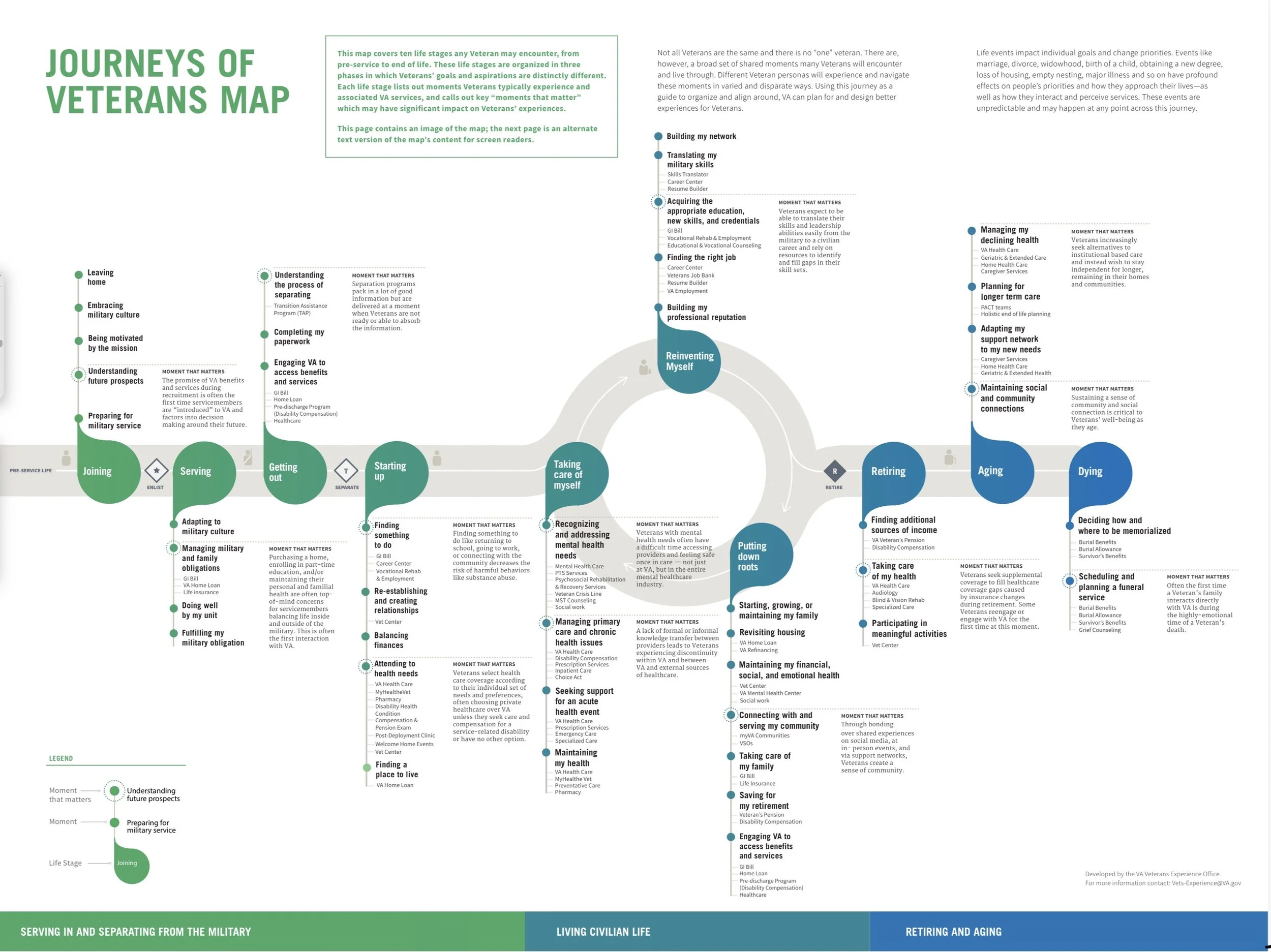
What Phase of Transition Are you In? Veteran Journey Map, Veterans Affairs
Resource Categories: What They Do (and Don’t Do)
1. Stabilization and Disability Support Resources
Best for: Preventing financial collapse, securing basic needs, disability-informed career planning
Life phase: Immediately post-separation, illness, family crisis, career exploration with disability
Examples:
- VA healthcare access
- Disability compensation
- Post-9/11 GI Bill housing allowance (BAH)
- VA home loans
- Vocational Rehabilitation & Employment (VR&E)
- State and municipal veteran benefits
- Transitional housing programs
- USO emergency assistance
What they do well:
- Keep you housed, fed, and insured
- Prevent medical debt and financial emergencies
- Buy time to figure things out
- Fund education/training aligned with disability constraints (VR&E)
- Help disabled veterans explore viable career paths
What they do NOT do:
- Tell you what career to pursue (except VR&E for disabled veterans)
- Build your professional network
- Make you more competitive for jobs
- Provide career direction on their own
Common misuse: Treating financial security as a complete transition strategy.
Key insight: These resources prevent disasters and provide breathing room. VR&E specifically helps disabled veterans find career paths that work with their limitations and funds the training. But having financial stability or even career funding doesn't automatically create momentum—that requires active work.
2. Campus and Institutional Veteran Communities
Best for: Building peer community, accessing veteran-specific opportunities, having a home base
Life phase: During college or university enrollment
Examples:
- Campus Student Veteran Services offices
- Syracuse University Institute for Veterans and Military Families (IVMF)
- University veteran resource centers
- Veteran student organizations
What they do well:
- Create veteran peer community and belonging
- Provide access to veteran-specific scholarships and funding
- Offer student employment and volunteer opportunities
- Give you a physical and social space to connect with other veterans
- Create conditions for organic networking and friendship
What they do NOT do:
- Automatically network for you
- Hand you job connections
- Build your career for you
Common misuse: Treating it purely as a social club without leveraging the community, scholarships, or opportunities it provides.
Key insight: The value comes from what you DO in that space—the friendships that turn into professional networks, the scholarships that fund better education choices, the work experience that goes on your resume. The office creates the conditions, but you have to act on them. This resource only exists while you're enrolled.
3. Professionalization and Translation Resources
Best for: Identity shift, norm learning, credibility building
Life phase: First serious civilian role, industry pivot
Examples:
- American Corporate Partners (mentorship)
- FourBlock (career readiness)
- Service to School (higher education prep)
- Vets in Tech
- Student Veterans of America
- Cohort-based leadership programs
- Veteran industry conferences
What they do well:
- Translate military experience into civilian terms
- Build weak ties
- Reduce cultural friction
- Provide social fluency
What they do NOT do:
- Guarantee placement
- Replace performance
Common misuse: Expecting transactional outcomes without iteration.
Key insight: This is identity reconstruction work, not job placement. The real output is social fluency and weak-tie access. Programs sometimes oversell placement rather than capability building.
4. Employment Aggregation Resources
Best for: Market scanning, volume applications
Life phase: Late-stage job search, parallel applications
Examples:
- RecruitMilitary (job boards and career fairs)
- GI Jobs
- State veteran job banks
- Hiring events and career fairs
What they do well:
- Increase exposure
- Reduce search costs
- Create awareness
What they do NOT do:
- Improve competitiveness
- Differentiate candidates
Common misuse: Confusing access with advantage.
Key insight: These optimize volume, not fit. They often benefit employers more than veterans at scale. Exposure does not equal competitiveness.
5. Crisis, Clinical, and Legal Interventions
Best for: Acute stress, legal barriers, mental health risk
Life phase: Any, but especially during destabilization
Examples:
- Veterans Crisis Line (988, press 1)
- VA mental health services
- Nonprofit legal aid clinics
- Pro bono mental health services
- Benefits appeals assistance
What they do well:
- Interrupt harm
- Restore baseline functioning
- Remove legal barriers
What they do NOT do:
- Build long-term capacity
Common misuse: Using emergency tools as planning tools.
Key insight: These are interruptive, not developmental. They’re designed to stop harm, not build futures. Fragmented handoffs are common.
6. Application and Artifact Services
Best for: Translating experience into legible proof
Life phase: Transition points and applications
Examples:
- Resume writing services (nonprofit and for-profit)
- VA disability claim preparation services
- VR&E application assistance
- College application support programs
What they do well:
- Improve signal clarity
- Convert life experience into legible artifacts
What they do NOT do:
- Decide direction for you
- Replace your judgment
Common misuse: Outsourcing judgment entirely.
Key insight: High leverage when ethical, predatory when not. Incentives can skew toward approval maximization rather than truth or alignment. Don’t let someone else decide what you should pursue.
7. Veteran ERGs and Internal Networks
Best for: Mobility, sponsorship, visibility
Life phase: After institutional entry
Examples:
- Corporate veteran employee resource groups
- Company affinity networks
- Industry-specific veteran groups within organizations
What they do well:
- Convert belonging into leverage
- Create internal opportunity paths
- Provide sponsorship
What they do NOT do:
- Replace performance or delivery
Common misuse: Treating them as social clubs without strategic engagement.
Key insight: These work best when you’re already inside an organization and need mobility or visibility. They create pathways, but you still need to perform.
8. Organic Social Spaces
Best for: Long-term opportunity emergence
Life phase: Ongoing, especially post-stabilization
Examples:
- Local running clubs or cycling groups
- Hiking and outdoor recreation communities
- CrossFit boxes and martial arts gyms
- Creative communities (writing groups, maker spaces)
- Church or faith communities
- Neighborhood associations
- Alumni networks
- Friends and family networks
- Reddit communities (r/Veterans, r/MilitaryFinance)
- Facebook groups (local veteran communities)
- LinkedIn informal networks
What they do well:
- Build trust before utility
- Create uncapped opportunity
- Provide honest informal knowledge
What they do NOT do:
- Produce immediate outcomes
Common misuse: Avoiding them because they don’t feel like “networking.”
Key insight: This is the shadow curriculum of transition. Often more honest than institutions. The best opportunities emerge from relationships built without transactional intent.
Quick Reference: Matching Life Events to Resources
| Life Event / Situation | Primary Resources | Secondary Resources | Examples |
|---|---|---|---|
| First year out of service | Stabilization + Navigation | Application services | Post-9/11 GI Bill, campus veteran office, VR&E counselor |
| Career pivot or industry change | Professionalization + Organic social spaces | Employment aggregation | FourBlock, Vets in Tech, industry meetups, LinkedIn networks |
| Underemployment / wrong fit | Artifact services + ERGs | Professionalization | Resume rewrite, internal veteran network, ACP mentorship |
| Burnout or crisis | Clinical intervention (first priority) | Stabilization | Veterans Crisis Line, VA mental health, disability compensation |
| Plateau inside a company | ERGs + Non-veteran social networks | Professionalization | Company veteran group, professional associations, alumni networks |
| Job search (active) | Employment aggregation + Artifact services | Professionalization | RecruitMilitary, Hire Heroes, resume services, LinkedIn |
| School/training enrollment | Navigation + Stabilization | Application services | Campus veteran office, GI Bill certification, Service to School |
| Family/health disruption | Stabilization + Clinical intervention | Navigation | VA healthcare, disability compensation, VR&E support |
| Building long-term career | Organic social spaces + ERGs | Professionalization | Running clubs, industry groups, company veteran network |
| Need capital/housing | Stabilization | Application services | VA home loan, veteran-friendly lenders |
| Legal barriers | Crisis/Clinical/Legal | Stabilization | Legal aid clinics, benefits appeals assistance |
Why This Reframing Is Important
When veterans understand what a resource is designed for, they stop blaming themselves or the system when it doesn’t deliver something it was never designed to provide.
This shift is psychologically important. It prevents resentment, reduces burnout, and allows you to be strategic rather than reactive.
You didn’t fail because RecruitMilitary didn’t get you a dream role. Job boards increase exposure—they don’t differentiate you. You didn’t waste time at a Student Veterans of America conference if you didn’t get hired on the spot. Conferences reduce cultural friction and build weak ties—they don’t guarantee placement.
Understanding this lets you use resources intentionally, in combination, and at the right time.
The Core Pattern Most Veterans Miss
Most veterans stall because they:
Over-index on transactional systems (job boards, career fairs, credential programs)
Under-invest in capability and identity reconstruction (professionalization, organic relationships)
The ecosystem is designed to mediate veterans into existing systems, not to help them author new trajectories. Once you see this pattern, you can work with it rather than against it.
A Diagnostic Question You Can Reuse
Before engaging with any veteran resource, ask yourself:
What problem am I solving right now?
What phase am I in?
What kind of leverage does this actually offer?
If you can’t answer all three clearly, step back and get clarity first. The resource will still be there when you’re ready to use it properly.
Final Thought
Veteran support resources fail veterans most often not because they are ineffective, but because they are used for the wrong goals, at the wrong time, for the wrong problems.
Now you have a framework to use them right.