Grace Within Constraint
How a Flag, Grand Canyon, a War, and an Eagle Taught Me to See
I grew up inside constraint: first as a Korean immigrant, then as a service member. In both places, obedience was not moral. It was survival.
Immigrant life teaches you to track social cues the way others track weather. Military life sharpens that instinct into command structure. Attention is not neutral. It is deployed. It seeks threat, assesses risk, obeys urgency. To wander is a liability. Ambiguity is risk.
I. Flag
On military bases, flags are everywhere. They mark boundaries, signal commands, direct traffic. Red flags mean danger. They tell you where not to go, what not to do. Your attention follows orders.
But sometimes my attention drifted.
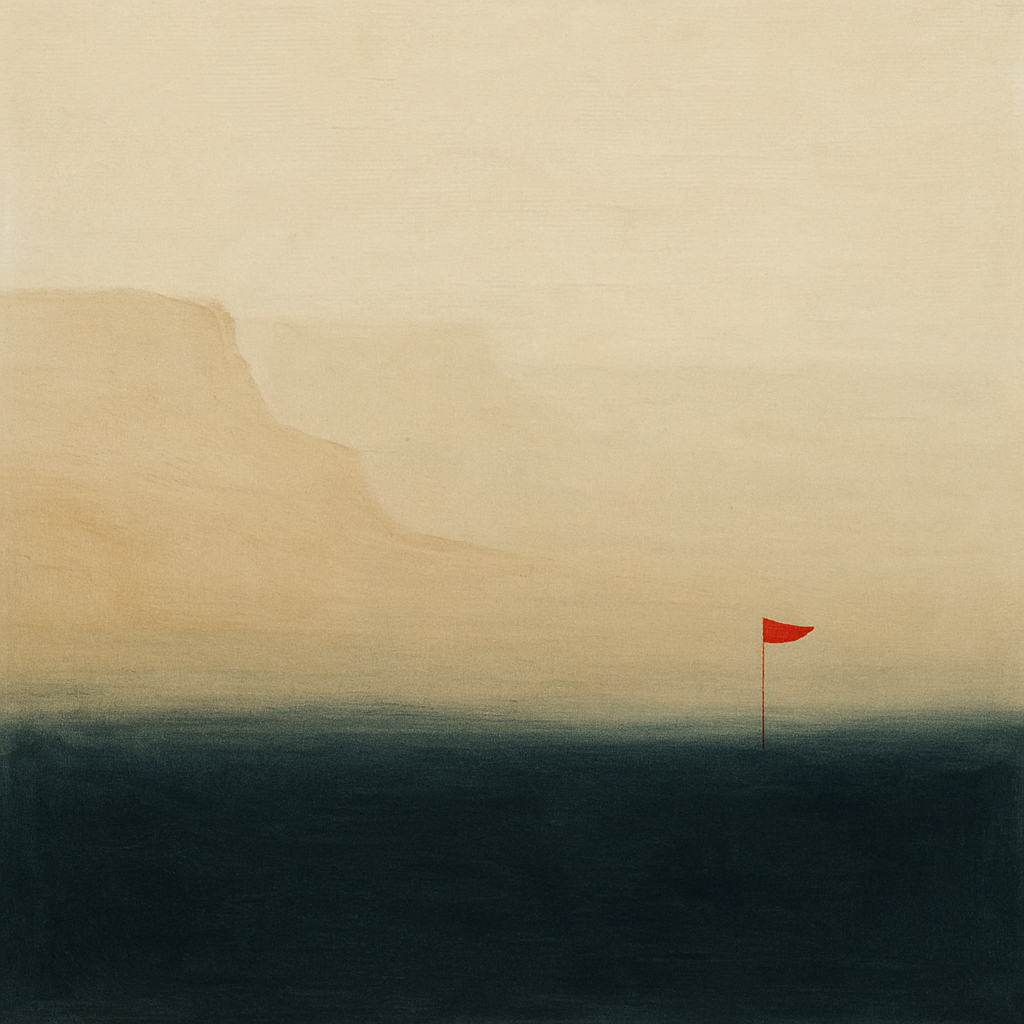
I found myself watching a flag: the way it moved with the wind, the fabric snapping and collapsing, snapping again. It offered no interpretation. It was not symbol or instruction. Just motion. Canvas and air.
There is an old story about a flag. A Zen master was teaching when the wind blew and a flag fluttered.
His students debated: Is the wind moving, or the flag? Some said wind, some said flag. The learned ones said neither: only movement itself exists.
Then the master said: It is your heart that moves.
I did not understand in the service what was moving. The flag fluttered in the direction of the wind, away from whatever I was supposed to be watching, away from the mission. As I felt the flag flutter, I longed to fly away with the wind. Away to home.
That moment felt like a reprieve. For the time it took to breathe, I was not a weapon.
I did not understand then what I was doing. I only knew that something in me refused, quietly, to stay fixed on what I was told to see.
II. The Canyon And The Eagle
Not long after leaving the military, I stood at the edge of the Grand Canyon.
The world had been ordered for so long that the Canyon's scale broke something open. For the first time in years, perception was not tethered to danger or demand. There was no threat to assess. No procedure to follow. Just vastness.
Then an eagle flew across the silence.
I watched it move through the air: not as a symbol of the nation, but as a body living inside gravity and necessity. It was likely hunting. Scanning for prey, driven by hunger, constrained by wind and weight and the need to kill to survive. It was not free from violence. It was not free from necessity.
And yet.
It moved with an internal logic that belonged only to itself. It was doing what it ought to do, in its own terms, and there was a kind of freedom in that: not freedom from constraint, but freedom within it.
I projected my longing onto that bird. The eagle was indifferent to my gaze, indifferent to my need for signs, indifferent to my search for a life after the military. My projection told me more about my confinement than about the eagle's liberation.
But projection is not falsehood. It is how meaning gets made.
The eagle did not promise me freedom. But watching it, I felt a possibility I had not named before: that I could live inside constraint without losing a sense of self. That grace and necessity could coexist. That I could consent to the inevitable without being crushed by it.
Which is more true: the eagle as it is, or the eagle as I needed to see it?
Both. Neither. The delusion is thinking you can separate them.
III. Attention and the Universe
Constraint shaped my attention before I ever understood what attention was. As an immigrant and service member, I learned to read the world for error and threat. Attention was not curious. It was defensive. It did not ask what things meant. It asked what things could do to me.
Later, beneath the stars in Marfa, the pattern broke.
Marfa is strange that way. To some it's just another West Texas town: empty buildings, vast sky, heat. To others (the ones who fly in from New York or LA, who recognize the names Donald Judd and Chinati Foundation) it's a profound artistic statement about space and emptiness. They come to appreciate the minimalism, to get away from it all, to find something authentic in the desert.
I wonder sometimes about this difference in seeing. Who gets to decide what's profound? Who gets to say this emptiness means something while that emptiness is just empty?
I visited Marfa as both insider and outsider. Not quite a tourist, not quite a local. A veteran learning to slow down, an immigrant learning to claim space, someone whose attention had been trained by survival and was now trying to drift.
The desert slowed my senses. The night sky pushed beyond my capacity to understand. I lay on a couch in the corner of a balcony for twenty minutes and let the starlight in. The sky was brilliant, star-studded, and I felt both awe and dread. I marveled at the sheer grandeur of it. I waited for the stars to crash down and vaporize me. I anticipated an airstrike (who is the enemy? I don't know) to leave me and this tiny town to dust. Iraq much?
In the vastness of West Texas, I saw objects and living things simply moving through their existence whether I watched them or not. A flower. A bee. A river. Each existed independently of my presence. To the universe I am infinitesimally insignificant, a brief existence, a speck of dust. To me, I am infinitely significant: there has never been, and will never be, anything alike in all times of existence.
Both are concurrently true. This is the mystery.
The world no longer felt like a stage where I had to earn my right to stand. It felt like something vast enough to hold me and indifferent enough not to depend on me.
Donald Judd's work was everywhere in Marfa: concrete boxes, metal planes, arrangements of space that refused interpretation. He once wrote, "the thing as it is is enough." I did not understand that sentence until I allowed perception to exist without instruction.
To accept that the universe is more than I can see does not erase me. It places me.
If the world is indifferent to my existence, then meaning is not something I can wait to be given. Meaning becomes something I choose to make. Human beings can place attention anywhere and ask it to matter. That is a kind of agency no institution can fully take away.
Maybe everyone has their own moments of cosmic revelation, their own ways of understanding their place in the vast universe. Some find it in desert art installations, others in city alleyways or factory night shifts. Who am I to say where profound truth lives?
And yet here I am in Marfa, having my own revelation among the art tourists and minimalist sculptures, thinking about who gets to make meaning from emptiness. The truth of simultaneous significance and insignificance doesn't belong to any one class or culture. It's there for anyone who looks up at a dark enough sky, whether they came for Donald Judd's boxes or just happened to find themselves in West Texas, wondering about their place in it all.
The universe does not sort violence from grace, chaos from choice, institution from beauty. It simply holds them at once.
IV. Iraq
In Iraq, the range became real.
Targets were not silhouettes. They were human beings with ancestors and futures. I wondered why we were killing each other at all. But the question was always cut short. If you hesitate, someone dies. Morality collapses into urgency.
At night, the pitch-black sky filled with stars. The Euphrates River flowed quietly in the distance. I remember locals who offered chai and flatbread when they had every reason not to (perhaps, no, most certainly so, yes it’s possible that they felt coerced, but I wish this wasn’t so). An old man gestured us into his home, pointed to the floor where we could sit, and brought out small cups on a metal tray. His hands were steady. Grace and violence existed in the same landscape, and neither canceled the other.
Those moments echoed the flag, Grand Canyon and the eagle, and the desert. My attention began to unhook itself from command. It did not reject the reality of war, but it reached past it. It saw the danger and it also saw the stars.
Albert Camus wrote that the absurd emerges from the confrontation between human need and the unreasonable silence of the world. In Iraq, I learned that silence is not always absence. Sometimes it is simply space: space where attention can move without permission.
We create rules and laws and culture and institutions because we cannot live without doing so. We cannot live alone. Constraint is not imposed from outside: it is woven into existence itself. Death drives us to it. The inevitable. We build systems to hold back the chaos, to make meaning in the face of indifference, to survive together.
And still, beneath those systems, attention can drift. It can find the flag in the wind, the stars above the war, the eagle moving through necessity with grace.
V. Grace Inside Necessity
Constraints do not disappear. I no longer expect them to.
The immigrant life, military training, the eagle's flight, the flag's motion, and even art itself: all live within structure. Freedom is not the absence of rules. It is the capacity to move with grace inside them.
Simone Weil described freedom as the ability to consent to necessity without losing oneself. That is what I saw in the eagle. That is what the Canyon allowed. That is what Marfa taught. That is what Iraq required.
To transition is not to escape history or institutions. It is to carry a fragment of one's own vision back into the world where rules still exist. The task is not to erase constraint. It is to place attention where life can still grow.
I did not begin my transition seeing like an artist in Marfa, or in Iraq, or even at the Canyon.
I began the moment I learned that my attention could drift away from instructions and still remain alive.
•••
The work now is to keep practicing that drift. To see again without being told what to find. To notice the flag before I notice the target. To let the universe be indifferent and vast, and to choose meaning anyway.
Not because constraint has ended, but because grace has always lived inside it.
The reprieve (the moment when attention slips, when the mind moves rather than the flag) must stay within. Must stay with us. My gaze at the eagle found peace, grace, and freedom in a creature that was anything but free. And yet the eagle was living its life within constraints, probably happy in human terms because it was doing what it ought to do in its own terms.
Perhaps that is what I was seeing. Perhaps that is what I was sensing and sharing.
The flag still flutters. The question remains: what is moving?
It is your heart that moves. It has always been your heart.